Brampton or Mississauga? Compare verified 2026 prices, property types, transit, schools, and investment returns across the GTA's two biggest Peel Region markets.
Two Peel Region Cities, Two Very Different 2026 Markets
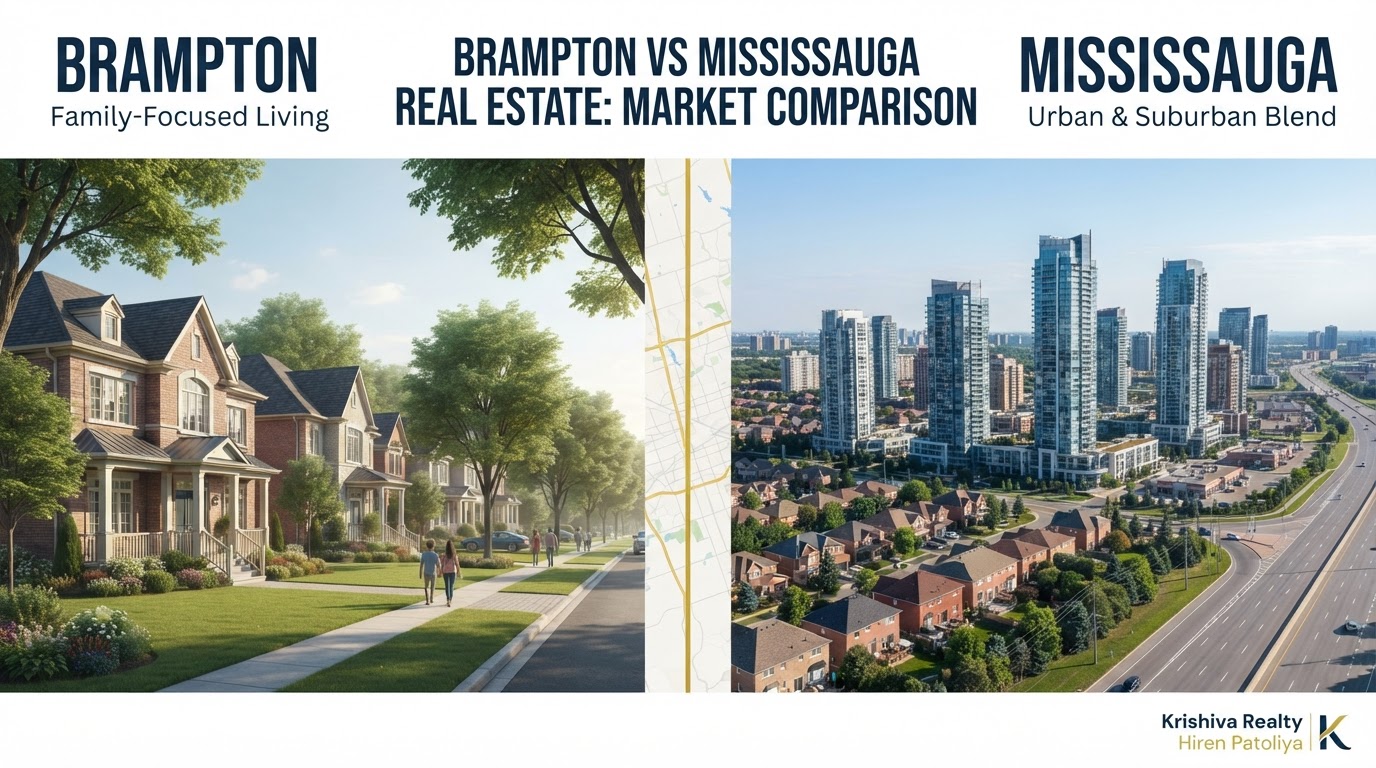
Brampton and Mississauga sit side by side in Peel Region, share major transit corridors, and are both anchors of the Greater Toronto Area — yet their 2026 housing markets are moving in opposite directions. TRREB's September 2026 data shows Brampton detached homes holding firm while Mississauga's condo segment continues to soften, and that divergence is reshaping where buyers, sellers, and investors are focusing. If you are choosing between these two cities this fall, the right answer depends on your budget, your timeline, and whether you are buying to live in, to rent out, or to build long-term equity. This comparison breaks down the verified numbers, the lifestyle trade-offs, and the practical questions that should guide your decision.
Verified Price Comparison (September 2026)
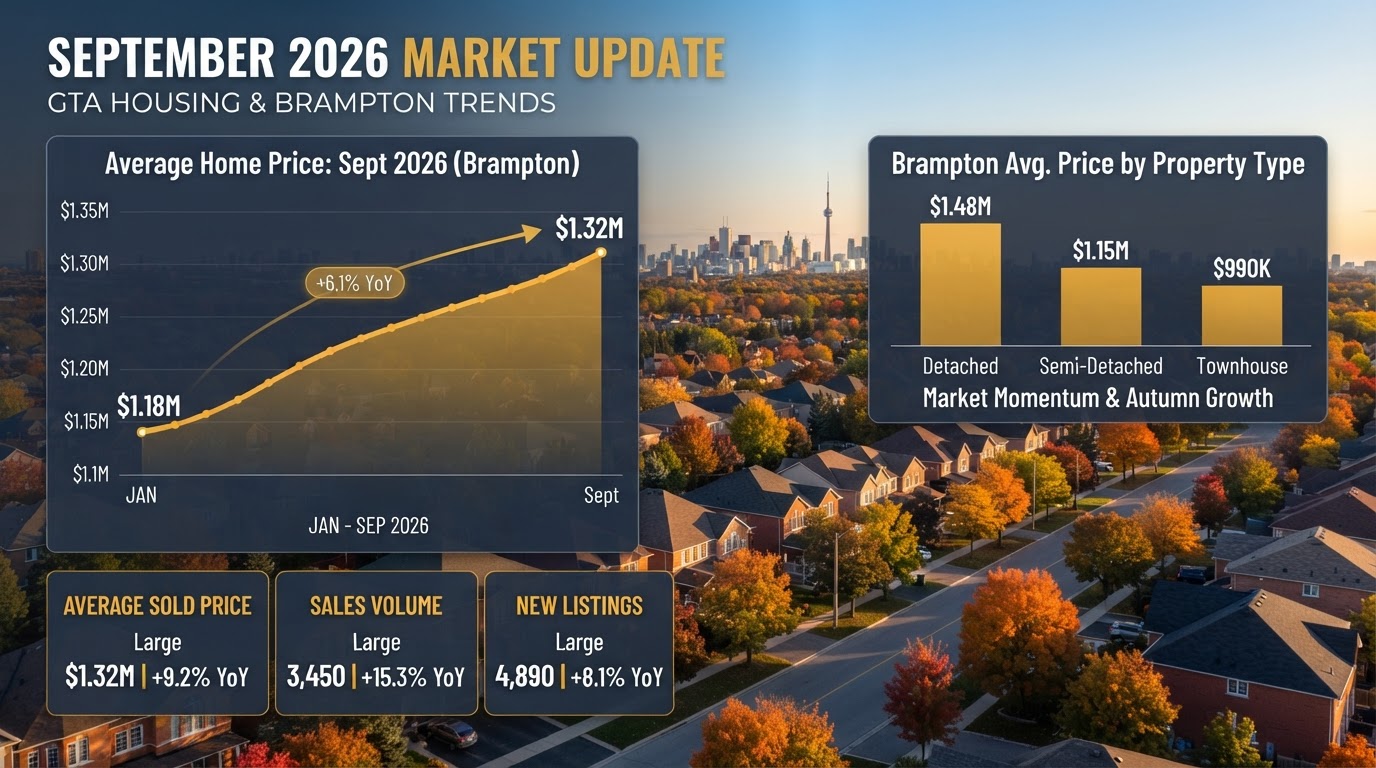
The price gap between the two cities is wider than most buyers assume. Brampton's overall average sale price across all property types was $854,322 in September 2026, with detached homes averaging $973,800 on the MLS HPI benchmark. Mississauga detached homes sat higher at roughly $1.42M on average, with premium pockets like Erin Mills and Lorne Park commanding even more. The condo story is the reverse of what most people expect: Mississauga condos averaged near $635K, down about 4.5% year-over-year, while Brampton condos were even more affordable at an average of $548,813 with a benchmark of $407,000 — down 11.9% year-over-year, the steepest decline of any major Brampton housing type. The takeaway: Brampton offers a lower entry point across every property type, while Mississauga commands a premium that reflects its location, density, and proximity to Toronto.
Property Type and Inventory
Brampton's housing stock is dominated by detached and semi-detached family homes, townhomes, and a growing number of low-rise subdivisions in the northwest (Mount Pleasant, Bram West). Condo apartments are a smaller share of the market, which is why the condo correction there is concentrated in a limited number of buildings. Mississauga, by contrast, has a much larger condo concentration downtown and around Square One, plus mature detached neighbourhoods in Erin Mills, Streetsville, and Lorne Park. If you want a detached home with a backyard and a driveway, Brampton gives you more square footage and lot size per dollar. If you want a condo lifestyle with walkability to restaurants, transit, and lake access, Mississauga's downtown corridor offers more options — and right now, more negotiating room on price.
Transit, Commute, and Accessibility
Both cities benefit from strong GO Transit connections, but the commute experience differs. Brampton's Mount Pleasant GO station offers a roughly 40-minute commute to Union Station, and the city is served by the Züm bus rapid transit network along major corridors. Mississauga is served by the MiWay transit system, the Cooksville, Port Credit, and Clarkson GO stations, and the upcoming Hurontario LRT, which will connect Port Credit to Brampton along Hurontario Street. If you commute to downtown Toronto, Mississauga's lakeside GO stations offer some of the fastest trip times in the western GTA. If you commute within Peel Region or to the 400-series industrial corridors, Brampton's highway access (401, 407, 410) is hard to beat. Your daily commute pattern should heavily influence which city fits your life.
Schools and Family Considerations
Both cities are served by the Peel District School Board and the Dufferin-Peel Catholic District School Board, with overlapping catchment quality. Mississauga's established neighbourhoods like Lorne Park and Erin Mills are known for consistently top-rated public schools, which supports detached price premiums. Brampton's Mount Pleasant, Credit Valley, and Springdale communities have strong school catchments and newer infrastructure, often at a lower price point than comparable Mississauga neighbourhoods. For families, the decision often comes down to budget versus neighbourhood maturity: Mississauga offers established, tree-lined communities with mature amenities; Brampton offers newer construction, larger lots, and modern community planning at a lower entry cost. Use the Peel District School Board school finder to compare specific catchments before you commit to a neighbourhood.
Rental Market and Investment Returns
For investors, Brampton has consistently led the GTA on cash-flow yield. One-bedroom rents averaged about $2,050 per month in Brampton versus $2,300 in Mississauga through 2026, but Brampton's lower purchase prices produce stronger gross rental yields — particularly for detached homes with legal second units in Heart Lake, South Brampton, and the L7A corridor, where gross yields of 5–7% are achievable. Mississauga's higher price points compress yields closer to 3–4% for condos, though the upcoming LRT corridor may support long-term appreciation. The Ontario 2026 rent increase guideline is 2.6%, and the LTB backlog still averages 8–10 months for standard hearings — both factors matter for landlords in either city. If your goal is monthly cash flow, Brampton's legal two-unit properties remain the stronger play. If your goal is appreciation tied to transit infrastructure, Mississauga's Hurontario corridor deserves a closer look.
Down Payment and Affordability Math
Let's compare a typical entry point in each city. On a $850,000 Brampton detached home with 20% down ($170,000), the mortgage is $680,000. At a 4.4% five-year fixed on a 30-year amortization, the monthly payment is roughly $3,765. On a $1.2M Mississauga detached with 20% down ($240,000), the mortgage is $960,000 and the monthly payment is about $5,315 — before accounting for the higher land transfer tax and property tax. That is a difference of over $1,500 per month, or $18,000 per year, not including the larger down payment required. For a household earning $130,000 with 20% down, Brampton's price range is comfortably within qualification at current rates, while Mississauga detached pushes the upper edge of affordability. First-time buyers should also stack the Ontario land transfer tax rebate (up to $4,000), the FHSA ($8,000 per year), and the Home Buyers' Plan (up to $60,000 from RRSP) — these apply equally in both cities.
Which City Fits You?
Choose Brampton if your priority is maximum square footage and lot size per dollar, newer construction, family-friendly suburban density, strong rental cash flow from legal second units, or a lower entry price for a detached home. Choose Mississauga if you value walkable condo lifestyle, faster downtown Toronto commute from lakeside GO stations, mature established neighbourhoods with premium school catchments, exposure to the upcoming Hurontario LRT appreciation thesis, or a larger condo inventory with negotiating room. Neither city is objectively better — they serve different buyer profiles and budgets. The right move is to match your property type, commute, and five-year plan to the city whose 2026 market conditions support it, then validate the specific neighbourhood with comparable sales data before you offer.
Frequently Asked Questions
Is Brampton cheaper than Mississauga? Yes — across every property type in September 2026, Brampton's average prices were lower, with detached homes around $854K-$973K versus Mississauga's $1.42M, and Brampton condos averaging $549K versus Mississauga's $635K. Which city has better rental returns? Brampton typically produces stronger gross rental yields, especially for detached homes with legal second units, where 5–7% gross yields are achievable. Which city has the better commute to Toronto? Mississauga's lakeside GO stations (Port Credit, Clarkson, Cooksville) offer some of the fastest trips to Union Station; Brampton's Mount Pleasant GO is roughly 40 minutes. Are Mississauga condos a good buy in 2026? For end-users and first-time buyers, the condo softening creates a genuine buying window; for investors, run a full cash-flow analysis first. Do both cities have first-time buyer incentives? Yes — the Ontario land transfer tax rebate, FHSA, and Home Buyers' Plan apply in both cities.
Compare Your Options With Real Data
Choosing between Brampton and Mississauga is not about picking the cheaper city — it is about matching your budget, commute, and goals to the market that supports them. I help buyers and investors compare both cities with customized comparable-sales analysis, neighbourhood-level pricing data, and a clear affordability breakdown across multiple rate scenarios. Book a free consultation today and let's map out which Peel Region city fits your next move in the GTA.