
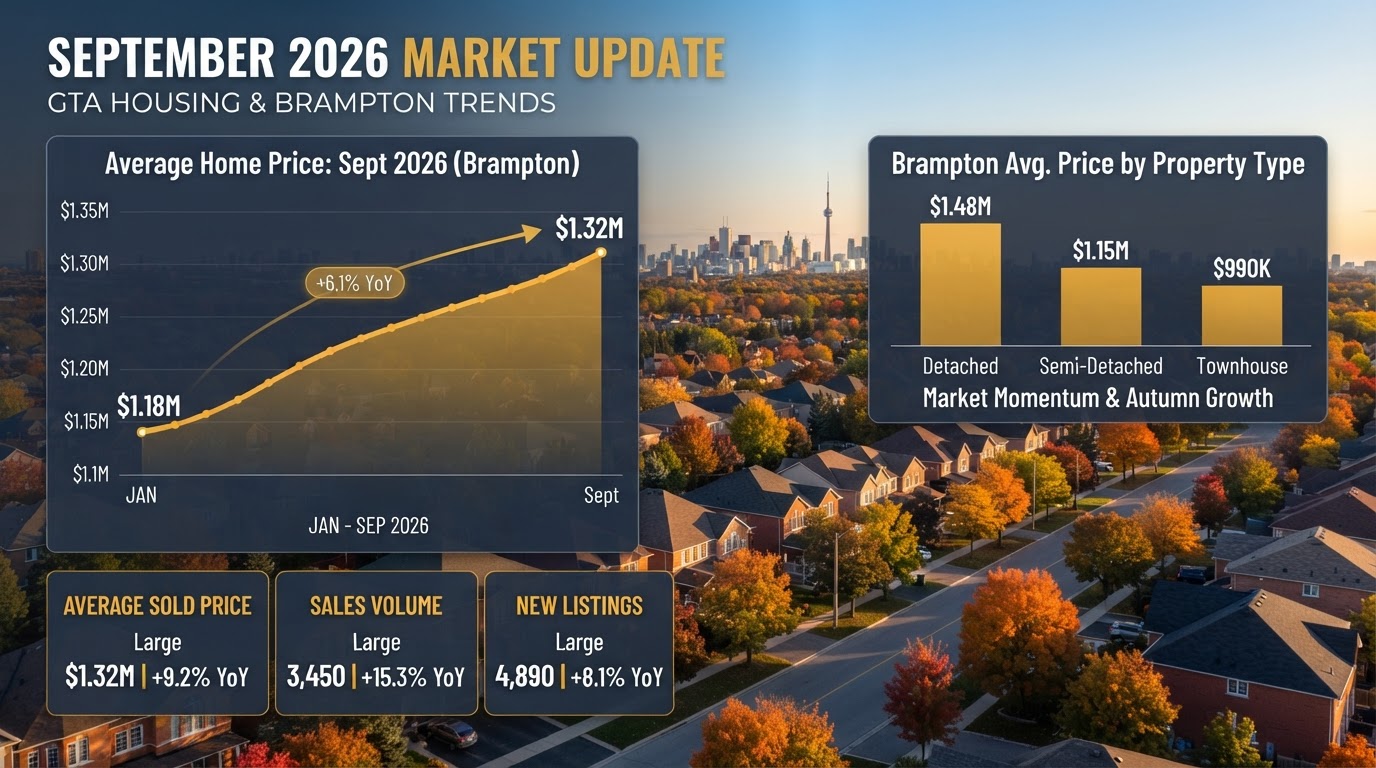
The Bank of Canada raised its policy rate to 2.50% on October 28. With TRREB September sales down 9% YoY and inflation at 3.1%, here's what buyers, sellers, investors, and business owners should plan for next.
A Rate Hike to Start November
On October 28, 2026, the Bank of Canada increased its overnight policy rate by 25 basis points to 2.50%. Statistics Canada reported September CPI at +3.1% year-over-year, and the next scheduled rate decision is December 9, 2026. This is not a mortgage offer; mortgage terms depend on your lender, your contract, and the product you hold. The point of this update is practical: borrowing costs just moved, the data behind the decision is public, and the right response depends on whether you're buying, selling, investing, or running a business across Brampton and the GTA. Let's separate the verified facts from what they actually mean for your next move.
The Verified Market Facts (September 2026)
These are September data points — not October results — and they reflect the GTA and national picture, not Brampton specifically. TRREB reported 5,040 GTA home sales in September 2026, down 9% year-over-year, at an average selling price of $1,006,409 (down 5.1% YoY) and an MLS HPI benchmark that fell 4.7% YoY. The average price reflects the sales mix, not the change in value of an individual home. CREA's September national sales fell 2.3% month-over-month, with 4.9 months of inventory nationally — a level CREA characterizes as broadly balanced at the national level, though conditions vary by local market and property type. Higher rates can restrain demand and inflation over time while benefiting some savers, but they also pressure indebted households, interest-sensitive spending, construction, and expansion. These are economic mechanisms — interpretations, not claims that every effect has already occurred.
What the Rate Move Means for Mortgages
Prime-linked borrowing responds to the policy rate subject to your lender and contract terms. On some variable-rate mortgages, payments rise; on fixed-payment variable products, more of each payment is allocated to interest. Existing fixed-rate mortgages generally hold their contracted rate until the end of their term — your payment does not change just because the Bank of Canada moved. New fixed-rate offers depend on bond yields and lender pricing, not one-for-one policy moves. If you're renewing soon or shopping for a mortgage, ask your lender whether a rate hold is available, for how long, and under what conditions — terms differ by lender and product, and a hold may not be offered or may carry conditions. See the Government of Canada's mortgage interest guidance for how mortgage interest works.
Opportunity, Pressure, and Action — At a Glance
The table below shows how the current environment may create openings and risks across four audiences. It is a planning framework, not advice; your circumstances, financing, and timeline always govern the right decision. Local market conditions vary, so treat each row as a prompt to check your specific situation rather than a blanket market call.
| Audience | Opportunity | Pressure | Action to consider |
|---|---|---|---|
| Buyers | Softer demand may create negotiating room on price, closing dates, and conditions | Borrowing costs can offset a lower purchase price | Refresh pre-approval; budget taxes, insurance, utilities, maintenance, condo fees, and a cash reserve |
| Sellers | If also buying, negotiating on the next home can offset softer sale proceeds | Tight buyer budgets may extend marketing time or reduce offers | Price from recent local comparables; calculate net proceeds, penalties, and bridge/carrying costs |
| Investors | Less competition may improve terms | Financing, vacancy, insurance, taxes, and repairs can erode return | Model cash flow after operations and debt service; stress-test vacancy and renewal costs |
| Business owners | Some cash savings may earn more | Floating loans, LOCs, and commercial borrowing may cost more; customer spending can soften | Review maturities, receivables, inventory, and project payback |
What This Means for Buyers
Softer demand can mean negotiating room on price, closing dates, and conditions — but higher borrowing costs can offset a lower purchase price, so the math has to work at today's rates, not last year's. Refresh your pre-approval so you know exactly what you qualify for after the October 28 move, and budget beyond the mortgage: land transfer tax, property tax, insurance, utilities, maintenance, and condo fees where relevant, plus a cash reserve for the unexpected. A lender's maximum is a ceiling, not a spending target — buy to a payment you can sustain through the full term, including renewal risk. National inventory figures reflect a broadly balanced national market, but conditions differ by neighbourhood and property type, so check the specific supply and absorption in the areas you're considering and decide which protective conditions (financing, inspection, status certificate review) fit your situation.
What This Means for Sellers
If you are selling and buying at the same time, negotiating on your next home can offset softer sale proceeds — the two transactions are connected, and softer conditions on the sell side can also appear on the buy side. Tight buyer budgets may extend your marketing time or reduce the offers you receive, so price from recent local comparable sales, not last year's numbers. Prepare carefully: professional photos, deferred maintenance addressed, and a clear showing strategy all matter when buyers have alternatives. Calculate your net proceeds, any mortgage penalties, and bridge or carrying costs before you list, so you know your floor and your timeline.
What This Means for Investors
Less competition may improve terms, but the same rate environment raises your financing cost and can pressure rents and vacancy. Model each property's cash flow after operating costs and debt service: mortgage, property tax, insurance, vacancy reserves, repairs, and management. Stress-test vacancy, repair, and renewal costs, and verify comparable rents and permitted uses before you underwrite — a second unit that is not legally permitted is a liability, not an asset. Avoid depending on appreciation or future rate cuts to make a deal work; if the numbers don't pencil at today's costs, the deal is not a deal yet.
What This Means for Business Owners
Some cash savings may now earn more, which is a modest tailwind for liquidity. On the other side, floating-rate loans, lines of credit, equipment finance, and commercial borrowing may cost more, and softer consumer spending can weigh on revenue. Review your maturities to see what is repricing and when, tighten receivables and inventory to free cash, and evaluate project payback against the new borrowing cost. Energy costs, tariffs, and demand shifts all interact with the rate environment, so model them together rather than in isolation. These are planning observations about economic mechanisms, not claims that any specific outcome has occurred.
Outlook Scenarios, Not Predictions
The path from here depends on inflation, employment, and the Bank of Canada's December 9 decision. In one scenario, easing inflation eventually eases financing pressure and brings sidelined buyers back. In another, persistent inflation keeps rates high or prompts further increases. In a third, weakening employment hurts demand even if rates are later cut. The disciplined approach is to plan using today's costs with a buffer, not a best-case forecast, and to remember that neighbourhood supply, property type, and your personal timeline matter more than national headlines. This is general market education only — financing terms and circumstances vary, and future outcomes are uncertain.
Plan Your Next Move
Whether you're buying, selling, investing, or running a business across Peel, Halton, and the GTA, the right response to a rate change is a plan built on today's numbers — not headlines. I provide clients with comparable-sale analysis, neighbourhood-level pricing data, and a clear action plan tied to your goals and timeline. Reach out by email at hpatoliya@krishiva.ca or call (647) 391-9502, and let's map out what the November rate move means for your specific situation. You can also book a free consultation to get started.